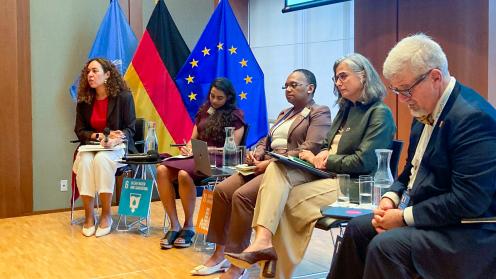
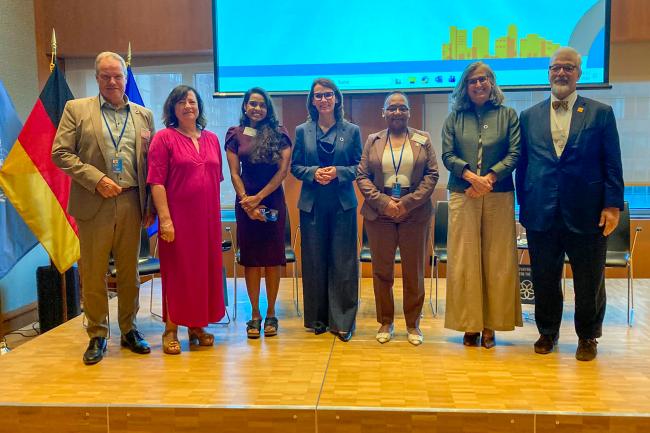
"Sponge cities" use nature-based solutions such as permeable pavements, green roofs, constructed wetlands, and urban gardens to absorb, store, and slowly release rainwater. Representatives from government, international organizations, and civil society considered the contribution of sponge cities to achieving three of the SDGs under review during the 2026 session of the High-Level Political Forum (HLPF) at a side event organized by the Government of Germany on 13 July 2026. Participants discussed challenges and lessons learned while implementing SDG 6 (clean water and sanitation), SDG 11 (sustainable cities and communities), and SDG 17 (partnerships for the goals), with a focus on efforts in Heidelberg, Germany, and Beira, Mozambique.
Ambassador Thomas Zahneisen, Deputy Permanent Representative of Germany to the UN, opened the side event at the German Mission to the UN.
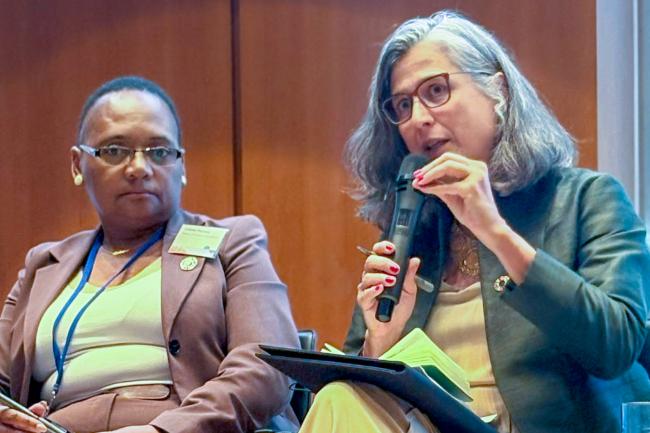
Rita Schwarzelühr-Sutter, Parliamentary State Secretary, Federal Ministry for the Environment, Climate Protection, Nature Conservation and Nuclear Safety, Germany, stressed that resilience is fundamental for achieving sustainable development and shaping the future. She noted the need to identify risks at an early stage and to support cities and municipalities to implement climate and biodiversity strategies. She added that sponge cities build on the concept of water-smart cities, and highlighted Germany’s role in co-chairing, with Mexico, the interactive dialogue on water governance at the December 2026 UN Water Conference.
Danielle Jean-Pierre Figueroa, Moderator, invited participants to reimagine urban water resources and said the side event would highlight sponge cities as a practical approach. During the event, she highlighted speakers’ emphasis on the need to be prepared and adapt, engage citizens actively, respond early, and address inequalities.
Eckart Würzner, Mayor of the City of Heidelberg, discussed good practices at the local level. He said his city runs its own energy company, which has facilitated efforts to adopt targets to achieve carbon neutrality. He said all buildings have to achieve higher standards than the US’ goal LEED standard to achieve this objective. He also reported that the city runs its own water utility and provides loans to small and medium-sized companies in the town, which creates a closed loop through which revenues are reinvested in the city.
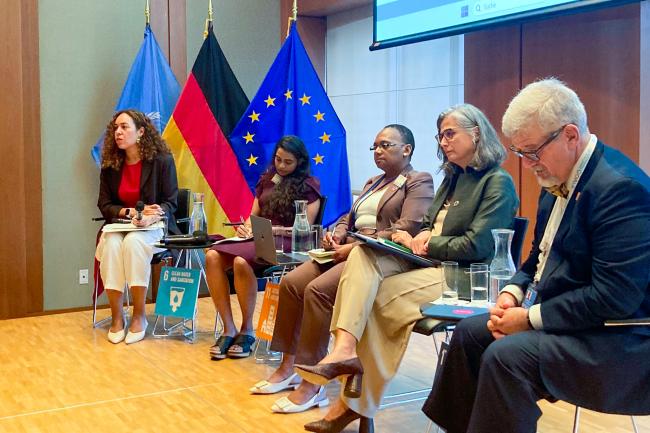
During a panel discussion, Sushmita Shekar, Youth representative, India, described efforts to respond to floods in India by bringing together blue, green, and grey infrastructure concepts within river basins and to mobilize youth to clean riverbeds.
Cristina Matusse, National Director of Planning and Budget, Ministry of Finance, Mozambique, outlined activities under their national development strategy, including the integration of resilience standards and land management efforts. She emphasized challenges in securing the level of investment needed to achieve all objectives.
Anacláudia Rossbach, Executive Director, UN-Habitat, emphasized the need to rethink the city of the future and noted that cities are on the frontline for climate change. She suggested that governments can embed the concept of sponge cities into their urban plans, national planning, and financial systems, and stressed the need to invest in solutions for informal settlements.
Ambassador Antonio Francisco Da Costa e Silva Neto, Co-Chair of the Coalition for High Ambition Multilevel Partnerships (CHAMP) for Climate Action, highlighted interconnections between SDG 11 and the New Urban Agenda. He said distinguishing between these agendas does not make sense for urban dwellers and noted that the solutions are intertwined. He said Brazil is a laboratory of fast urbanization. Noting that Brazil’s cities are producing inequality, he called for inclusive as well as resilient cities.
In response to a question about what changes panelists would like to see in the future, speakers emphasized that the future is urban and said we need to: listen to cities and local level actors; strengthen local governments; provide necessary resources; and think Beyond GDP and consider how environmental resilience can be an important measure for success. Co-creation and investments in social infrastructure were emphasized, as well as the need to create a leadership movement.
Bärbel Kofler, Parliamentary State Secretary, Federal Minister for Economic Cooperation and Development, Germany, closed the event highlighting four points: develop targeted multilateral, multilevel cooperation; improve subnational finance; continue capacity building and mutual learning efforts, bringing in the knowledge of all stakeholders in cities; and adopt a cross-sectoral and integrated approach for all solutions.
To receive free coverage of global environmental events delivered to your inbox, subscribe to the ENB Update newsletter.