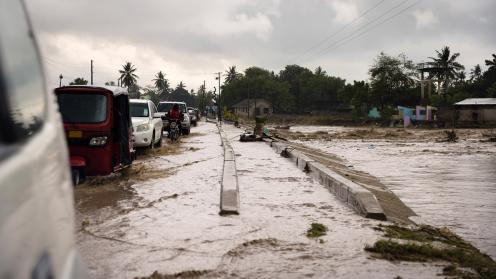

Disaster risk management and reduction is a complex, but attainable, endeavor that requires an integrated, cross-sectoral approach, innovative financing, whole-of-government and whole-of-society involvement, and accurate and timely data and risk information. These points were highlighted by speakers and participants during the first day of the Ninth Session of the Africa Regional Platform for Disaster Risk Reduction (AfRP-9).
The meeting opened with a musical performance by the National Cultural Group of Namibia. In his keynote address, John Mutorwa, Deputy Prime Minister, Namibia, speaking on behalf of Saara Kuugongelwa, Prime Minister of Namibia, underlined AfRP-9 as an opportunity for experience sharing and peer learning among African countries to accelerate implementation of the Sendai Framework on Disaster Risk Reduction (DRR) and its Programme of Action for Africa. Master of Ceremonies I-Ben Natangwe Nashandi, Executive Director, Office of the Prime Minister, Namibia, called for AfRP-9 to chart a sustainable course for resilience building and risk reduction for Africa.
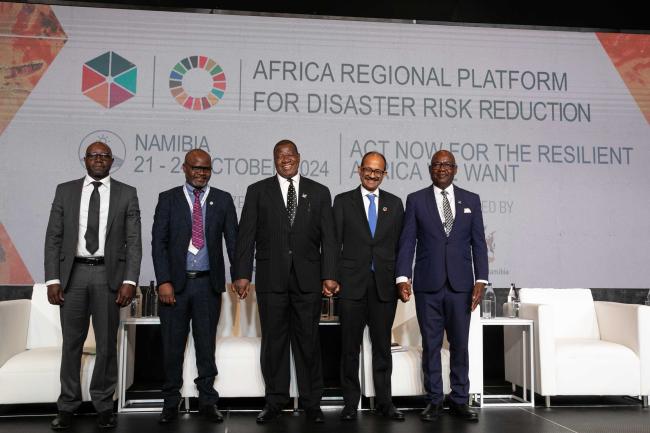
Kamal Kishore, Special Representative of the UN Secretary-General for DRR, commended Africa on its progress in building resilience, including the first adoption of early warning systems. He encouraged applying the Ubuntu concept that our shared humanity connects us all, to cooperate to fulfill the aspirations of Africa’s Agenda 2063. Anderson Banda, Director, Southern African Development Community (SADC) Humanitarian and Emergency Coordination Centre, urged mainstreaming DRR in climate change adaptation, risk governance, and national development plans.
Harsen Nyambe, Director of Blue Economy and Sustainable Environment, African Union Commission, highlighted that in 2022 alone, disasters caused an estimated economic loss of USD 9.5 billion for the continent. He said to address these losses and challenges, Africa must cultivate the ability to feed itself even in the face of droughts, and put in place, among others, the right infrastructure and transportation systems.
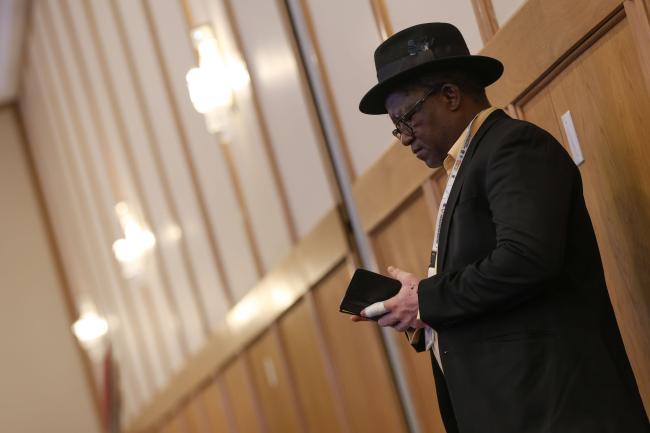
Following the opening ceremony, participants gathered in sessions addressing a variety of topics related to enhancing Africa’s resilience and disaster preparedness. In a session on applying risk information for transformative governance, speakers urged investing in accessible data systems that include robust data collection and risk assessments, pursuing practical community-based solutions, and ensuring risk information can be understood by the most vulnerable. In another session, on investing to reduce risk, speakers recalled studies showing that Africa experienced total losses of 12.3% of GDP between 2015 and 2021 and that USD 800 billion is expected to be lost annually due to disasters. They identified the need for a review of the global financial architecture, noting that interest rates offered to African countries are significantly higher than the global average. Speakers also described innovative instruments for leveraging the needed finance for DRR, such as blended finance, debt-for-nature swaps, green bonds, and blue bonds.
Three thematic sessions focused on: risk-informed policymaking; legislation, standards, and regulations; and leveraging technology to reduce disaster risks, and losses and damages. During these sessions, participants deep dived into the key issues that need to be addressed to build the needed framework to manage disaster risk on the continent. The importance of data, joined-up decision-making, and implementation of standards and legislation was underlined by participants.
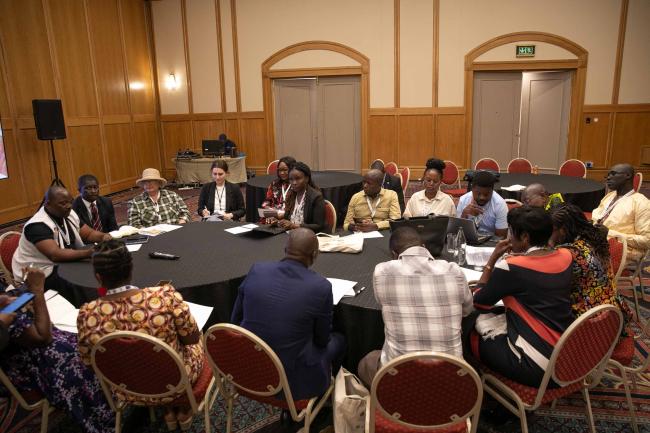
Working sessions were also held throughout the day to provide an additional opportunity for a wide range of stakeholders to engage in interactive discussions on the theme of AfRP-9. Participants used flipcharts, whiteboard, and small group discussions to develop and share ideas on topics, including reducing disaster risks on an urbanizing continent and mainstreaming disaster resilient infrastructure in Africa. Representatives of cities also showcased their responses to disasters using innovative methods such as Kenya's Lamu County's award-winning Emergency Operation Centre and the Democratic Republic of the Congo’s Bukavu Disaster Management Clubs.
To receive free coverage of global environmental events delivered to your inbox, subscribe to the ENB Update newsletter.
All ENB photos are free to use with attribution. For AfRP-9, please use: Photo by IISD/ENB | Kiara Worth.
Opening Ceremony

Delegates are welcomed to AfRP-9 with a traditional Namibian dance performance.


Delegates gather in plenary for the opening ceremony of AfRP-9

Kamal Kishore, Special Representative of the UN Secretary-General for DRR, and Head, UNDRR

Anderson Banda, Director, SADC Humanitarian and Emergency Coordination Centre

John Mutorwa, Deputy Prime Minister, Namibia

Harsen Nyambe, Director, Blue Economy and Sustainable Environment, AUC

I-Ben Natangwe Nashandi, Executive Director, Office of the Prime Minister, Namibia

Delegates listen to the interventions
Plenary Sessions Throughout the Day

Panel speakers during the session 'Applying Risk Information for Transformative Governance', moderated by Amjad Abbashar, Chief, UNDRR Regional Office for Africa

Hellen Likando, Director, Directorate Disaster Risk Management, Office of the Prime Minister, Namibia

Dorcas Wangu, Humanitarian Response Coordinator, Oxfam

Jean-Rigobert Tshimanga Musunganyi, Permanent Secretary, Ministry of Interior, Democratic Republic of the Congo

Surekha Ramessur, Senior Programme Officer, Meteorology, SADC Climate Services Centre

Delegates ask questions from the floor

The Ombetja Yehinga Organisation (OYO), a Namibian youth organization, perform a piece titled 'Calling the Rain', highlighting the many challenges faced by local communities


Kamal Kishore, Special Representative of the UN Secretary-General for DRR, and Head, UNDRR, delivers a keynote address during the plenary session 'Investing to Reduce Risk'

James Murombedzi, Chief, Climate Change Section, Technology, Climate Change and Natural Resource Management Division, UN Economic Commission for Africa (UNECA)

Rohey John-Manjang, Minister of Environment, Climate Change and Natural Resources, The Gambia

Gabriel Pollen, National Coordinator, Disaster Management and Mitigation Unit, Zambia

A slide shows the current lack of water flow at Victoria Falls, highlighting the severe impact climate change is having across the continent

Thematic Sessions Throughout the Day

Panel speakers for the thematic session 'Risk Informed Policy'

Grace Mercy Osewe, County Executive Committee Member in-charge of Governance, Administration, Communication and Devolution, Homa Bay County, Kenya

Gatkuoth Kai, Regional Coordinator for Africa, Disaster Risk Reduction and Recovery, UN Development Programme (UNDP)

Pamela Komujuni Kalule, Senior Disaster Management Officer, Office of the Prime Minister, Uganda

Cecilia Aipira, Chief of Branch, Ecosystems Division, UN Environment Programme (UNEP)

A slide highlights the importance of incorporating DRR into national planning frameworks to ensure that vulnerability is avoided

Panel speakers during the thematic session 'Legislation, Standards and Regulations'

Ranjini Mukherjee, Director, Research, Knowledge Management and Capacity Development, Coalition for Disaster Resilient Infrastructure (CDRI)

Emmanuel Kasimbazi, Professor and Chair, University of Makerere Environmental Law Centre

Panel speakers for the thematic session 'Leveraging Technology to Reduce Disaster Risks, Losses and Damages'

Ahmed Amdihun, Programme Coordinator, Intergovernmental Authority on Development (IGAD) Climate Prediction and Applications Centre (ICPAC)

Idris Halima Ohunene, Senior Scientific Officer, Nigeria National Space Research and Development Agency (NASRDA)

A presentation highlights how technology is being used to predict disasters and aid planning
Working Sessions Throughout the Day

Delegates attend a working session focused on reducing disaster risks

Shee Kupi Shee, Lamu County, Kenya

Queen Omagano Kamati, Mayor of Windhoek, Namibia

Delegates break out into groups to do a deep-dive into a variety of questions

Participants of the working session gather for a family photo

Alpana Saha, Director, Partnerships, Governance, and Resource Mobilisation, CDRI India

John Kissi, Director, Hydrological Services Department, Ghana

Press Conference

A press conference is held to emphasize the importance of the AfRP-9

Anderson Banda, Director, SADC Humanitarian and Emergency Coordination Centre

Kamal Kishore, Special Representative of the UN Secretary-General for DRR, and Head, UNDRR


Local journalists document the proceedings

I-Ben Natangwe Nashandi, Executive Director, Office of the Prime Minister, Namibia

Around the Venue

Kamal Kishore, Special Representative of the UN Secretary-General for DRR, and Head, UNDRR, holds a special roundtable discussion with National DRR Focal Points

Kamal Kishore, Special Representative of the UN Secretary-General for DRR, and Head, UNDRR

National DRR Focal Points from across the region share their views

Delegates meet informally between sessions


Delegates pose for photos between sessions


Materials on display around the venue


