
About
The ICJ interpreted the “tapestry of States’ obligations” under international law, providing a clear legal benchmark against which to assess climate action. Crucially, it rejected some high-emitting countries’ argument of the pre-eminence of the climate treaties in defining obligations and consequences for failing to live up to them.
Final report
Summary report 23 July 2025
All coverage
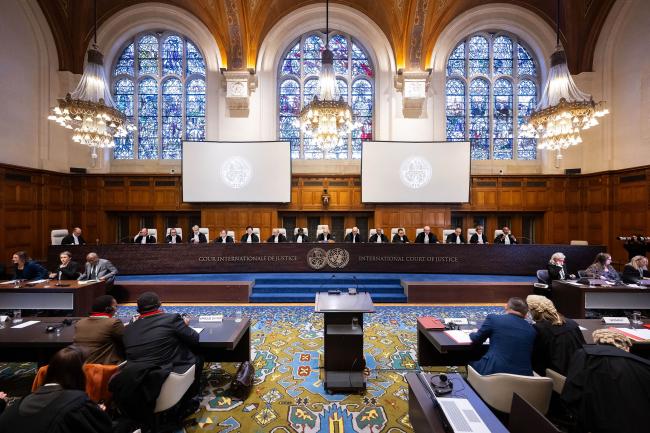
The International Court of Justice (ICJ) delivered its much-anticipated advisory opinion on States’ obligations with respect to climate change. As the culmination of a two-year-long process that has captured attention all around the world, President of the Court, Judge Iwasawa Yuji, read out the outcome of the Court’s deliberations at a public sitting at the Peace Palace.
In 2023, the UN General Assembly (UNGA) requested the ICJ to clarify:
- the obligations of States under international law to ensure the protection of the climate system and other parts of the environment from anthropogenic emissions of greenhouse gases for States and for present and future generations; and
- the legal consequences under these obligations for States where they, by their acts and omissions, have caused significant harm to the climate system and other parts of the environment, with respect to:
- States, including, in particular, small island developing States, which due to their geographical circumstances and level of development, are injured or specially affected by or are particularly vulnerable to the adverse effects of climate change; and
- peoples and individuals of the present and future generations affected by the adverse effects of climate change.
A record 91 written submissions, over 100 oral statements, and 65 responses to the judges’ follow-up questions have informed the Court’s deliberations on the matter brought forward by the UNGA. Countries and admitted organizations touched upon various issues, which the advisory opinion is expected to address, including:
- the scope of States’ legal obligations, with some defending the pre-eminence of the UN Framework Convention on Climate Change, the Kyoto Protocol, and the Paris Agreement on climate change and others emphasizing States’ broader obligations under international law;
- the precautionary principle and the duty to avoid transboundary harm;
- human rights, such as the right to self-determination, the right to a healthy environment, and the rights of future generations;
- the transition away from fossil fuels, including the regulation of private actors in this regard; and
- the consequences for failing to live up to obligations, such as reparations for damage caused.
The International Tribunal for the Law of the Sea (ITLOS) and the Inter-American Court of Human Rights (IACtHR) had already rendered advisory opinions on climate change when the ICJ released its opinion. The African Court on Human and Peoples’ Rights also recently received a similar request. Against this backdrop, the ICJ stood out as the only court with both general and universal jurisdiction to rule on similar issues. Its advisory opinion was expected to provide a clear legal benchmark that will serve as precedent for court cases around the world. It also contributes to setting the tone of UN climate negotiations going forward.
World’s Youth for Climate Justice organized a demonstration outside the Peace Palace to follow the reading of the advisory opinion. In various other cities, non-governmental organizations organized events for stakeholders to jointly watch the reading and reflect on the outcome of the proceedings.
The advisory opinion was delivered at 3:00 pm CEST on Wednesday, 23 July 2025, at the Peace Palace in The Hague, Netherlands. It was livestreamed on UN Web TV.
To receive free coverage of global environmental events delivered to your inbox, subscribe to the ENB Update newsletter.