About
A side event that took place during the the 2025 Bonn Climate Change Conference had representatives from UN agencies and national governments discussing UN resources and national-level actions to mainstream and implement water-related measures in Nationally Determined Contributions (NDCs) and National Adaptation Plans (NAPs).
The UN system has created several tools, frameworks, strategies, and initiatives that can support countries in mainstreaming and implementing water-related measures into their Nationally Determined Contributions (NDCs), National Adaptation Plans (NAPs), and the global climate process. At the same time, governments, the private sector, and civil society are learning lessons as they seek to mainstream water into their national climate policies and plans.
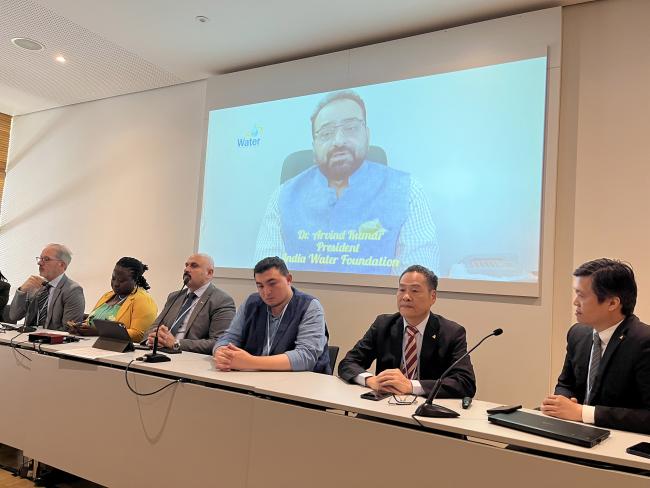
Representatives from UN agencies and national governments came together to discuss these UN resources and national-level actions during an event held on the sidelines of the 2025 Bonn Climate Change Conference. The event was intended to provide input to the Baku Dialogue on Water for Climate Action by fostering an exchange of experiences among countries and partners. The event also contributed to the implementation of the UN System-wide Strategy on Water and Sanitation.
The event was co-organized by the UN Economic Commission for Europe (UNECE), World Meteorological Organization (WMO), and UN Environment Programme (UNEP) in the framework of the UN-Water Expert Group on Water and Climate Change, and by Azerbaijan as COP29 Presidency coordinating the Baku Dialogue on Water for Climate Action, as well as Arizona State University, the Association of Sustainable Ecological Engineering Development, and India Water Foundation.
Sonja Koeppel, Secretary of the Convention on the Protection and Use of Transboundary Watercourses and International Lakes (Water Convention), opened the event and noted that many climate change impacts are transmitted thorough the water cycle. She stressed that water, like climate, is a transboundary issue and is an essential part of national mitigation and adaption planning.

Approaches and Tools for Mainstreaming Water into National and Global Climate Processes
Martin Krause, Director, Climate Change Division, UNEP, highlighted that freshwater ecosystems play a key role in capturing carbon but they are being drained, degraded and under strain by climate change, pollution and unsustainable human activities which is affecting entire ecosystems and their ability to deliver freshwater and other ecosystem services upon which our lives depend. He noted that NAPs and NDCs can accelerate action, stressing the importance of Integrated Water Resources Management (IWRM) principles and approaches, and said the Baku Dialogue on Water for Climate Action seeks to support transformation at speed and scale.
Raj Bhushan Choudhary, Minister of State, Ministry of Jal Shakti, India, discussed the experience of mainstreaming water into climate policy in India. He emphasized that water is at the heart of building a climate-resilient future, noting that India has integrated water into its NDC and is boosting tree planting, among other actions, to enable climate solutions.
Kamala Huseynli-Abishova, COP 29 Presidency, Azerbaijan, informed participants about the Baku Dialogue on Water for Climate Action, for which UNEP is the host and UNECE and WMO are partners. She recalled that it was launched on Nature and Biodiversity Day to emphasize the links between water, nature, and biodiversity. She highlighted the importance of transboundary cooperation as well as the shared challenges all countries face in addressing floods and droughts.
Nicolas Franke, WMO, on behalf of UN-Water, recalled that the UN System-wide Strategy on Water and Sanitation, which was launched in 2024, identifies efforts to align UN system support. He reiterated that UN-Water is ready to provide technical expertise, scientific input, and policy advice to strengthen global and national climate-related programmes. He also highlighted the opportunity to include water in mitigation and just transition activities.
Hanna Plotnykova, Water Convention Secretariat, UNECE, discussed the findings of a report on Mainstreaming Water Supply, Sanitation and Transboundary Water Management and Cooperation into NDCs and NAPs. She reported that, with respect to transboundary water management and cooperation, the document recommends that countries can:
- apply transboundary basin assessments while developing baseline assessments for NAPs and NDCs;
- engage transboundary basin organizations;
- develop and/or revise transboundary agreements to ensure they are climate-proof;
- use the Water Convention as a platform to strengthen transboundary cooperation; and
- secure and mobilize financing for transboundary projects.

Experiences in Mainstreaming Water into New and Revised NDCs and NAPs as well as other National Climate Policies
Jay Famiglietti, Arizona State University, moderated this session. Yousif Muayad, Ministry of Environment, Iraq, described his government’s efforts and lessons learned in integrating water into their NDC. Noting the agriculture sector accounts for 75% of water use in Iraq, he said the country has focused on irrigation technology, among other activities. He explained that his country’s NDC will focus on adaptation and ambition in the water sector as well as loss and damage (L&D). He called attention to challenges including drought and social, economic, and health ramifications of climate change.
Annette Nantongo, Ministry of Water and Environment, Uganda, reported her government has prepared several sectoral NAPs, including for health. She said Uganda is currently preparing a NAP on WASH (water, sanitation and hygiene), which will examine WASH infrastructure, service providers, and communities. She also shared that the country has prepared vulnerability assessments for two water basins and identified priority actions for transboundary water. She recommended ensuring that planning processes: have strong coordination frameworks that support vertical and horizontal linkages to support implementation; and that countries conduct climate risk and vulnerability assessments to guide prioritization of actions.
Rustam Nassirkhan, Ministry of Ecology and Natural Resources, Kazakhstan, described regional cooperation to prepare climate vulnerability assessments, which identified actions to include in their NAP. He said Kazakhstan’s third NDC has tried to use Article 6 (cooperative approaches) as much as possible to mobilize finance, including through regional cooperation.
Chen Jui Wen, Association of Sustainable Ecological Engineering Development (ASEED), shared information on JW Eco-Technology as a Tool for Water and Climate Change Adaptation. He said JW (joy for water) is a technology aimed at transforming storm water to ground water by filtering and storing it under ground, and using it as needed.
In a video message, Arvind Kumar, President, Indian Water Foundation, discussed efforts to ensure water was included as a cross-cutting issue in India’s national plans, and noted that water is a connector for addressing institutional fragmentation. He also stressed the importance of integrating Indigenous Peoples and practices into national plans.
During the discussion, audience members inquired about the role of nature-based solutions (NbS) as solutions for water scarcity. Speakers noted that they consider NbS and ecosystem-based approaches, including in the context of building water storage methods and sustainable dams and restoring degraded land. In response to a question about areas where water is discussed in the UNFCCC process, speakers mentioned the current emphasis on water inclusion in talks on the Global Goal for Adaptation (GGA) and L&D, and highlighted that protection, restoration, and sustainable management of water ecosystems also contributes to mitigation measures.

Closing Remarks
Karin Zaunberger, European Commission, closed the event, explaining that the IPBES Nexus Assessment showed that climate, water, biodiversity, food and health are linked but our policies are not. She highlighted that the COP 30 Presidency’s just-released fourth letter calls for a Global Mutirão and accelerating solutions on the ground. She also called attention to the EC’s recent launch of the European Water Resilience Strategy, which aims to restore and protect the water cycle, secure clean and affordable water for all, and create a sustainable and resilient water-economy in Europe.
Participants were informed that the first interim meeting of the Baku Dialogue on Water for Climate Action, a COP-to-COP collaboration platform fostering continuity and coherence on water-related climate action, would take place on 21 June 2025, on the sidelines of the Bonn Climate Change Conference.

To receive free coverage of global environmental events delivered to your inbox, subscribe to the ENB Update newsletter.
The Earth Negotiations Bulletin (ENB) writers for this event are Lynn Wagner, Ph.D.; and Valentina Romoli. The Digital Editor is Diego Noguera. The Editor is Leila Mead.