
The contrast was stark on Wednesday, between the high expectations for the Agreement to lead to a step-change in the conservation and sustainable use of biodiversity beyond jurisdiction (BBNJ), on the one hand, and the reality and pace of intergovernmental negotiations, on the other.
Discussions were especially tedious in the morning. As the Preparatory Commission reflected on the rules of procedure and modalities of work of various subsidiary bodies, there was a lot of repetition in delegates’ statements. They reiterated their general expectations with regard to the procedure for nominating and electing members to the subsidiary bodies, the capacity in which these members would serve, the length of their terms, and the importance of collaboration among subsidiary bodies and with other international frameworks and bodies (IFBs).
Speaking for Greenpeace, Jane Fonda reminded delegates that although their deliberations are taking place in secluded windowless rooms, millions of people around the world are rooting for them to make swift progress. “We live in an increasingly divided world, and protecting nature can feel impossible, but we cannot allow ourselves to despair,” she emphasized. She called the BBNJ Treaty “a beacon of hope,” which will help to punch back against the tide of extraction and corporate greed. She urged delegates to lobby for a quick ratification of the Agreement, emphasizing its importance for reaching the Global Biodiversity Framework’s 30x30 target on Ocean protection.
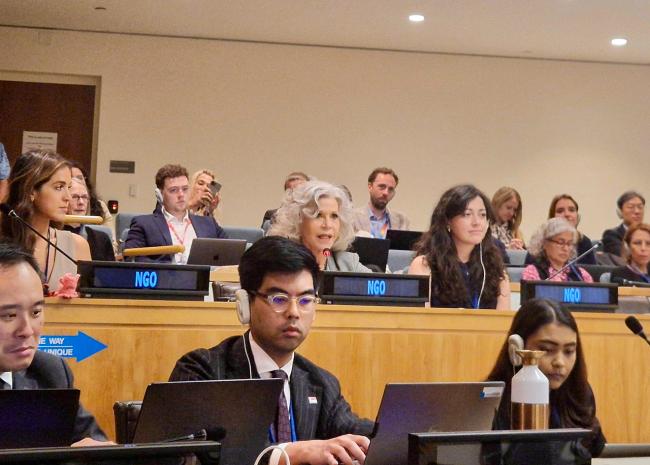
In the afternoon, delegates cut back on reiterating their well-known points and provided more specific comments on expectations for the Implementation and Compliance Committee (ICC). They emphasized the need to clearly delineate, among others:
- safeguards regarding conflicts of interest;
- the process for parties to submit reports to the ICC;
- how the ICC would draw on information from other subsidiary bodies and IFBs;
- triggers to enable the Committee to offer support to parties; and
- the process to develop a recommendation for the Conference of the Parties to issue a statement regarding a party’s implementation and compliance.
The Co-Chairs indicated that they will prepare a matrix outlining specific elements relevant to each subsidiary body for consideration at the next session of the Preparatory Commission. The idea is to visualize parties’ proposals, for example with regard to the size and composition of the bodies.
Later, delegates resumed discussions on the Clearing-House Mechanism (CHM). They reiterated support for an incremental approach to setting up the CHM, with the PrepCom to clarify which core functions the CHM should deliver on during the initial phase, such as:
- generating BBNJ batch identifiers, considering that marine genetic resources might be collected between the entry into force of the Agreement and the first meeting of the COP;
- sharing information on planned activities to enable consultations for environmental impact assessments; and
- matching capacity and technology needs with available support.
On Thursday, delegates will reflect on issues to be addressed at the Preparatory Commission’s next session, scheduled for August 2025.


To receive free coverage of global environmental events delivered to your inbox, subscribe to the ENB Update newsletter.
All ENB photos are free to use with attribution. For this meeting, please use: Photo by IISD/ENB.